
Insert Headline
Insert text here.
Insert Headline
Insert text here.
The Stamp Act Riots Part Two: August 26th & 27th, 1765
by David J Samuels | November 18, 2025
In the previous post, you read about how, on August 14th, 1765 a possibly well intentioned act of civil disobedience planned by Whig (Patriot) leader Samuel Adams and his lieutenants to protest the Stamp Act got out of hand and turned into vicious acts of political violence. A mob destroyed Stamp Tax Master Andrew Oliver’s office and house, and threatened Lieutenant Governor and Chief Justice Thomas Hutchinson. The mob demanded that Hutchinson swear he had opposed the Stamp Act. Hutchinson had, in fact, vehemently opposed the Stamp Act. However, faced with an angry mob, Thomas Hutchinson refused to back down. He remained in his house and waited for the destruction to begin. Instead, the mob dispersed when a neighbor told them they’d seen Hutchinson fleeing in his carriage. But the mob would return to his house twelve days later.
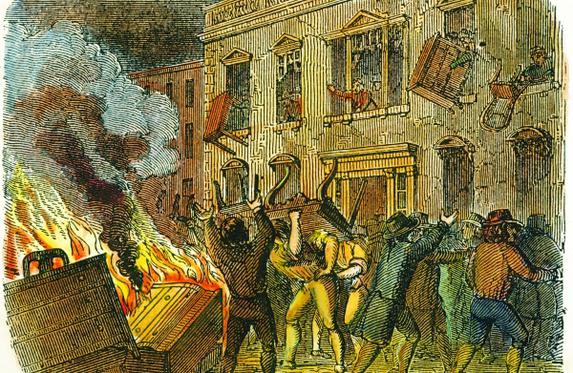









On the night of August 26th, 1765, bonfires were built and lit on King Street (now State Street) and the air was filled with the defiant sounds of whistles and horns and shouts of “Liberty and Property!”
The mob split up, with one group marching to the living quarters of an official of the Vice-Admiralty Court named William Story. Story had been accused of assembling a stack of depositions accusing certain Boston merchants of smuggling. Though he’d denied these accusations in the morning paper, the mob apparently didn’t believe him. The ransacked his living quarters, supposedly looking for the depositions in question. In the process, they destroyed much of the Admiralty’s archives.
8/26/1765
Main Sources
That morning, August 27th, 1765, Hutchinson appeared in court in his role as Chief Justice. He was disheveled, wearing a combination of the lightweight house clothing he had been wearing when the mob arrived and bits of borrowed clothing to protect him from the cold. Patriot lawyer-in-training Josiah Quincy, Jr described Hutchinson’s appearance:
Closing Thoughts on the Stamp Act Riots
“Such a man in such a station, thus habited, with tears starting from his eyes and a countenance that strongly told the inward anguish of his soul.”
1. Patriots by AJ Langguth
2. Cradle of Violence by Russell Bourne
3. “Ordinary Americans” on Great Courses
8/27/1765
Thomas Hutchinson swore by God that he had never, in any way or any place, supported the Stamp Act. He said he did not make this declaration out of fear, because he had nothing to fear. There was nothing left to take but his life, which was worth little without his “creature comforts” which had already been taken from him. He protested his innocence, while also stating that violence was wrong, regardless of innocence or guilt. He said:
“I hope all will see how easily the people may be deluded, inflamed and carried away with madness against an innocent man. I pray God give us better hearts!”
Hutchinson’s response to the Stamp Act Riots is, in my opinion, relevant today. Think about how easily people today seem to be whipped into a frenzy, how easily they seem to ignore facts, to act on rumors, to act on stereotypes, to act from a place of ignorance, and not just against individuals. Think about the acts of political and social violence that have been committed against both individuals and groups and the threats of the same that seem to always accompany rallies and protests these days.
The stories of the Stamp Act Riots and the tradition of rioting in Colonial Boston in general are often fun to tell. They certainly were when I started in this business 25 years ago. Now though, they seem to have a renewed relevance to current events, to the lack of dialogue and the threat of violence that pervades politics in our time.
The United States of America has been defined by both positives and negatives. Those negatives may have defined us in the past and some may continue to define us. But those lingering negatives don’t have to continue to define us. Perhaps we can change and chart a new course, if we can develop better hearts.
Thank you for taking the time to read these posts. Please consider joining us on a Tour of the Freedom Trail to hear stories of the founding of this great country on your next visit to our great city.
Thanks again,
David J Samuels
Founder & Managing Partner
The Histrionic Academy, LLC
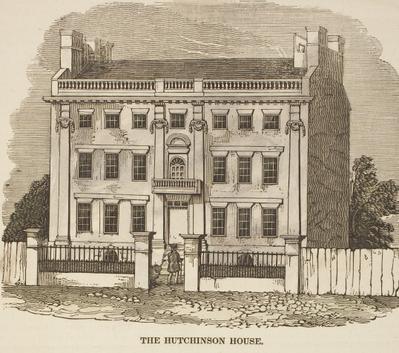
Contrary to what the mob believed, Thomas Hutchinson had opposed the Stamp Act, going as far as to write to the government in London, counseling against it. But he was ignored. Furthermore, rumors began to circulate around town that Hutchinson had not only wholeheartedly supported the Stamp, but also wrote the law himself in his Mansion in Boston’s North End.
Thomas Hutchinson was a man of principle and believed in the existing social and economic order, and the rule of law, and wholeheartedly supported these ideals. So when the Stamp Act was passed, regardless of whether he supported it, he considered it the law of the land and would support and enforce it. This by itself made it easy for Samuel Adams and other Whig (Patriot) leaders to aim the anger of ordinary Bostonians at Thomas Hutchinson.
Taking it further, Samuel Adams and his lieutenants encouraged the belief that Hutchinson had enthusiastically supported the Stamp Act, making Hutchinson and his family priority targets for the mobs of already angry ordinary people.
Thomas Hutchinson had been told that the mob would not attack him because they admired the fact that he had stood up to them the other night. Some may have, others may perhaps not so much. Regardless, this supposed “admiration” didn’t stop the mob from having another go at Hutchinson and his house. Thomas Hutchinson and his family were having supper when a friend arrived and warned him that the mob was on the way. Hutchinson told his family to leave but refused to leave himself, until one of his daughters, Sarah, told him if he stayed, so would she. The family fled to a neighbor’s house just minutes before the mob arrived.
The mob chopped their way through the doors with axes. There were cries of “Damn him, he’s upstairs! We’ll have him!” and a part of the mob headed upstairs. Another part of the mob ransacked Hutchinson’s liquor cellar. The mob was more violent than the protests and riots of August 14th. They smashed the walls between rooms, smashed and shattered windows, slashed open mattresses and pillows from the second floor and threw the feathers out the window onto the lawn. They climbed all the way up to the cupola of the house and, after a great deal of determination and hard work, managed to break it loose from the structure of the house and throw it off of the roof. The mob destroyed the fruit trees and the shrubs on the property. They shredded clothing, smashed dishes, and broke expensive imported mirrors. They stole 900 pounds cash and scattered and destroyed manuscripts Hutchinson wrote about the Massachusetts Bay Colony, which his family had helped to found and where he had been born and raised. The mob did the same with Hutchinson’s collection of rare historical documents. At 4am the next morning, there were still rioters on the roof, pulling it apart. With the rising of the sun, the mob dispersed, having only just stopped short of pulling the whole house down.
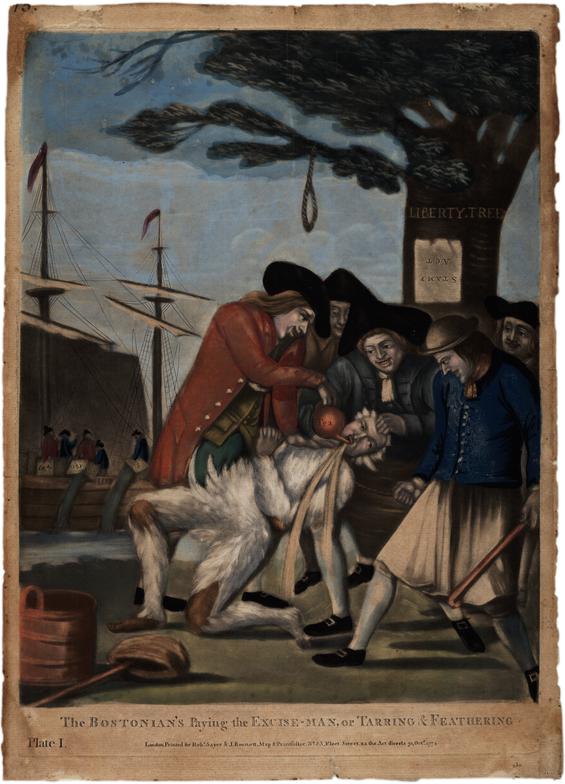
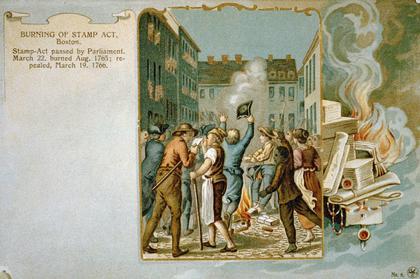
On the night of August 26th, 1765, bonfires were built and lit on King Street (now State Street) and the air was filled with the defiant sounds of whistles and horns and shouts of “Liberty and Property!”
The mob split up, with one group marching to the living quarters of an official of the Vice-Admiralty Court named William Story. Story had been accused of assembling a stack of depositions accusing certain Boston merchants of smuggling. Though he’d denied these accusations in the morning paper, the mob apparently didn’t believe him. The ransacked his living quarters, supposedly looking for the depositions in question. In the process, they destroyed much of the Admiralty’s archives.
The other part of the mob went to the home of Benjamin Hallowell, the Comptroller of Customs. The reasons for this were as much economic as political. Most ordinary Bostonians struggled to earn 60 pounds a year. Meanwhile, Hallowell had just spent over 2000 pounds on a new house. In protest of this display of extravagance, the mob attacked his house. They ripped off doors and windows, drank his wine cellar dry, and carried off official papers.
Next, the mob gathered at the house of Lieutenant Governor and Chief Justice Thomas Hutchinson.